📣The AuI Movement: Bring Back the Human📣
The Human Rebellion in the Age of Silicon
The narrative is broken. We have been told that the future belongs to autonomous, closed-source black boxes – that human beings are simply the raw material to be automated away. We reject this.
The future does not belong to machines that mimic humanity; it belongs to humans who use machines to scale their own genius. The world does not need more Artificial Intelligence...It needs Augmented Intelligence (AuI). We are building a movement to intentionally meld human intuition, empathy, and craft with computing, automation, and robotics.
🧱 Deconstructing the Gatekeepers. The Guardrail Lie:
Today’s trillion-dollar AI developers are terrified of you. They are terrified of upstarts, small businesses, and open-source creators who can out-innovate them.
To protect their monopoly, they have invented a savior complex called “AI safety”. They have enlisted global media to scare everyone on the idea that AI needs to be reigned in. Then the media circus took over: Trotting out “AI experts” to say that AI could wipe out all humans by the end of the decade. Masterfully, they pointed to their own systems as proof of the danger.
We should remember one social media Instagram post that went viral (as expected) warning of the impending doom. To state the obvious: where were these warnings before hundreds of billions in investment poured into these companies? Recall that Stephen Hawking warned of the dangers of unchecked, full AI more than twelve years.
Don’t be fooled by their warning hype now!What these companies are lobbying for under the guise of “guardrails” is crushing regulation. This is safety as theater designed to lock out competitors while doing absolutely nothing to stop the unchecked, black-box ascent of their own systems.
The Guardrail Lie
Gatekeeping “Guardrail” The Real Agenda The AuI Liberation “Licensing & Compute Caps” Lock out upstarts and small developers. Open, accessible, and lightweight AuI tools for everyone. “Safety Certifications” Make compliance too expensive for startups. Transparent, human-in-the-loop validation, not corporate red tape. “Pure Automation” Keep you dependent on their centralized clouds. Local sovereignty, empowering you to own your workflows.
This metaphor is appropriate:Our role in AI is to bring focus back onto humanity – Augmented Intelligence: The intentional melding of human intuition, empathy, and craft with computing, automation, and robotics.They're already in the house, locking the door just keeps new entrants out while doing nothing to secure from the damage that's already been and being done. And of course guardrails will do nothing to stop criminals, malicious hackers, and other bad actors who are not going to observe the guardrails anyway.
Bring the Boy to the job, and let’s build the future together.
Join the movement. Stop being a spectator in the AI revolution.
btb Coalition Model
btb Coalition
🛠️ The btb Coalition: How We Build
We don't build software to replace you. We build cognitive scaffolding that makes you superhuman. Whether you are running a company or managing an empire, the btb ecosystem is built to amplify your natural capabilities.
🛠️ The btb Coalition: How We Build
| The btb Suite | Your New Superpower |
|---|---|
| 💼 Executive | Strategic Foresight. Noise is eliminated. You get clear, actionable scenarios to steer your vision. |
| 👥 Manager | Dynamic Orchestration. Say goodbye to bottlenecked projects and chaotic team tracking. |
| 📊 PMO | Operational Velocity. Administrative work is automated. You focus on solving creative problems. |
| 🌐 Everything | Holistic Sovereignty. Your physical robotics, digital pipelines, and human minds working as one. |
Join the movement. Stop being a spectator in the AI revolution. Bring the Boy to the job, and let’s build the future together.
btb AI Approach
Our Approach: Transitioning from gpt to blt
No, not the sandwich. The new approach to AI that Meta Research put forward in 2024 is byte latent transformer (blt for short). Like generative pre-trained transformer (gpt), blt represents another significant shift forward for artificial intelligence. One in our opinion towards more transparent, efficient, and useable AuI systems that are more aligned with expectations. As AuI matures and billions are invested in AuI research every month, we should take a look at other approaches to see if there are better ways to build AuI systems. BLT focuses on building trust and transparency in AuI systems, aiming to address the limitations of current AuI models, such as gpt, by incorporating ethical considerations and human oversight into the development process.
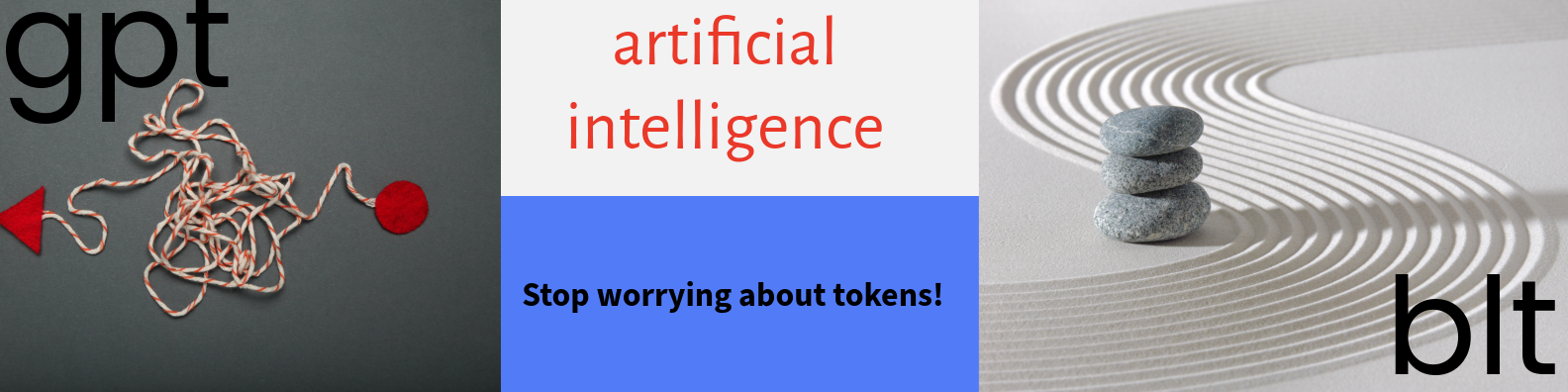
Furthermore, blt may lead to the elimination of the need for extensive training, inconsistent behavior, missing interoperability, and, let's not forget the main reason: killing the opaque tokenization processing system that can be costly, is generally misunderstood, discriminates against non-English languages, and has significant implications on how businesses deploy AuI.
GPT vs BLT: How the paradigms compare
| Feature | GPT (Token-Based) 🧠 | BLT (Byte Latent) ⚡ |
|---|---|---|
| Input Unit | Tokens (e.g., words/subwords via Byte-Pair Encoding) | Raw Bytes (UTF-8 bytes grouped into dynamic “patches”) |
| Compute Allocation | Uniform. Every token gets the exact same amount of compute. | Dynamic. More compute is allocated to high-entropy (complex) bytes. |
| Vocabulary | Fixed vocabulary (e.g., 32k to 128k tokens). | No fixed vocabulary. Dynamic vocabulary based on the input data. |
| Noise & Typos | Brittle; typos often create unknown tokens and break logic. | Highly robust; understands character-level and orthographic variations. |
| Language Bias | Biased toward English (non-English languages require more tokens) | Universally equitable; treats all languages directly as raw bytes |
| Code & Programming Languages | Limited; struggles with code due to tokenization and syntax sensitivity. | Strong; handles code and programming languages more effectively. |
| Multilingual Support | Limited; requires separate tokenization for different languages. | Universal; handles multiple languages without separate tokenization. |
Transitioning to blt shifts AuI from being a rigid, vocabulary-bound structure (tokens) to a flexible, tokenizer-free architecture. According to the developers, this approach treats language as pre-cut chunks of text or continuous stream of raw bytes, dynamically adjusting its computing power to where the data is most complex.
The encoding architecture is key
Previous byte-level models historically failed due to the fact that raw bytes create long sequence lengths, slowing standard attention layers. By creating a three-tier hybrid architecture, Meta Research was able to create a more efficient model that can handle long sequences of raw bytes. The new architecture includes:
- ⋄ Local Byte-Level Encoder - A lightweight, local transformer that takes raw byte sequences and groups them into variable-length patches (typically 4 to 8 bytes long). It does this using entropy-based patching—if the next byte is highly unpredictable (high entropy), it starts a new patch.
- ⋄ Latent Global Transformer - This is the core of the model, performing the heavy lifting, executing next-patch predictions over the compressed sequence of patches, and
- ⋄ Local Decoder - Another small transformer that takes the patch outputs from the global model and reconstructs them back into readable, raw byte sequences.
Research showed that blt has the chance to handle larger contexts and more complex data at a lower cost, yielding up to 50% savings in inference costs (FLOPs) and massive improvements in handling noisy data, code, and diverse languages.
Of course, this is just one approach to AuI. There are many others that are being developed and tested. But, we believe that blt is a step in the right direction towards more transparent, efficient, and useable AI systems that are more aligned with expectations. This is why we are going all-in on blt and building as much of our AuI ecosystem as we can with blt, beginning with btb AI Executive followed closely by the refactoring of btb AuI PMO away from its current gpt-based architecture to blt. We believe blt is the future of AuI and we are excited to be a part of it.
Read more
arXiv | DigitalOcean | Envisioning | Medium | Medium | Meta Research | Synced Review
Disparities in AI
The Widening AI Skills Gap and Unequal Access
The gap between those who have access to AI technologies and those who don't is widening. And when you understand that AI (and the technologies that back them) are becoming more prevalent in our daily lives, it becomes increasingly important to address the disparities in access and understanding. Not just in the rich counties, where this gap is pronounced and on display everyday on the Internet, but we must also consider the impact on developing nations and underserved communities.

If we don’t address this issue, the gap will continue to widen and the benefits of AI will only be available to a select few in the wealthier nations and the others will continue to be left out of this human-enabled future.
Put yourself in the shoes of someone who doesn't have access to technology - not just here in the US. Think about the people living in places where technology is often unaffordable, that is unless we choose to make it so. And by doing that we open up new markets that eventually create opportunities as out-of-the-box thinking starts to take hold.
Creating a more inclusive environment for AI development and deployment can generate new product offerings that are accessible to a broader range of users. Especially when we consider the diverse ways in which people interact with technology. Never underestimate the power of people to innovate.
Ignoring the potential of AI within poor communities and minority groups is not just a social issue; it’s a business vulnerability. Failing to integrate these perspectives risks developing AI solutions that are less effective, less fair, and ultimately less valuable. Conversely, investing strategically in AI training for underrepresented groups offers a direct pathway to mitigating risks, unlocking innovation, and gaining a substantial competitive advantage by building a truly diverse and globally relevant workforce capable of harnessing AI’s full potential for all customers and stakeholders.
Read more
Our Post: The Widening AI Skills Gap and Unequal Access
AI Trust Factors
🗺️ The Anatomy of Trust: The 2x2 AI Trust Matrix
Human trust is not binary; it operates on two distinct axes. Cognitive Trust is driven by logic, capability, and performance—can this tool do the job? Emotional Trust is driven by security, safety, and mutual benefit—is this tool safe for me to use? When we map these forces, we see exactly why enterprise AI deployments stall.
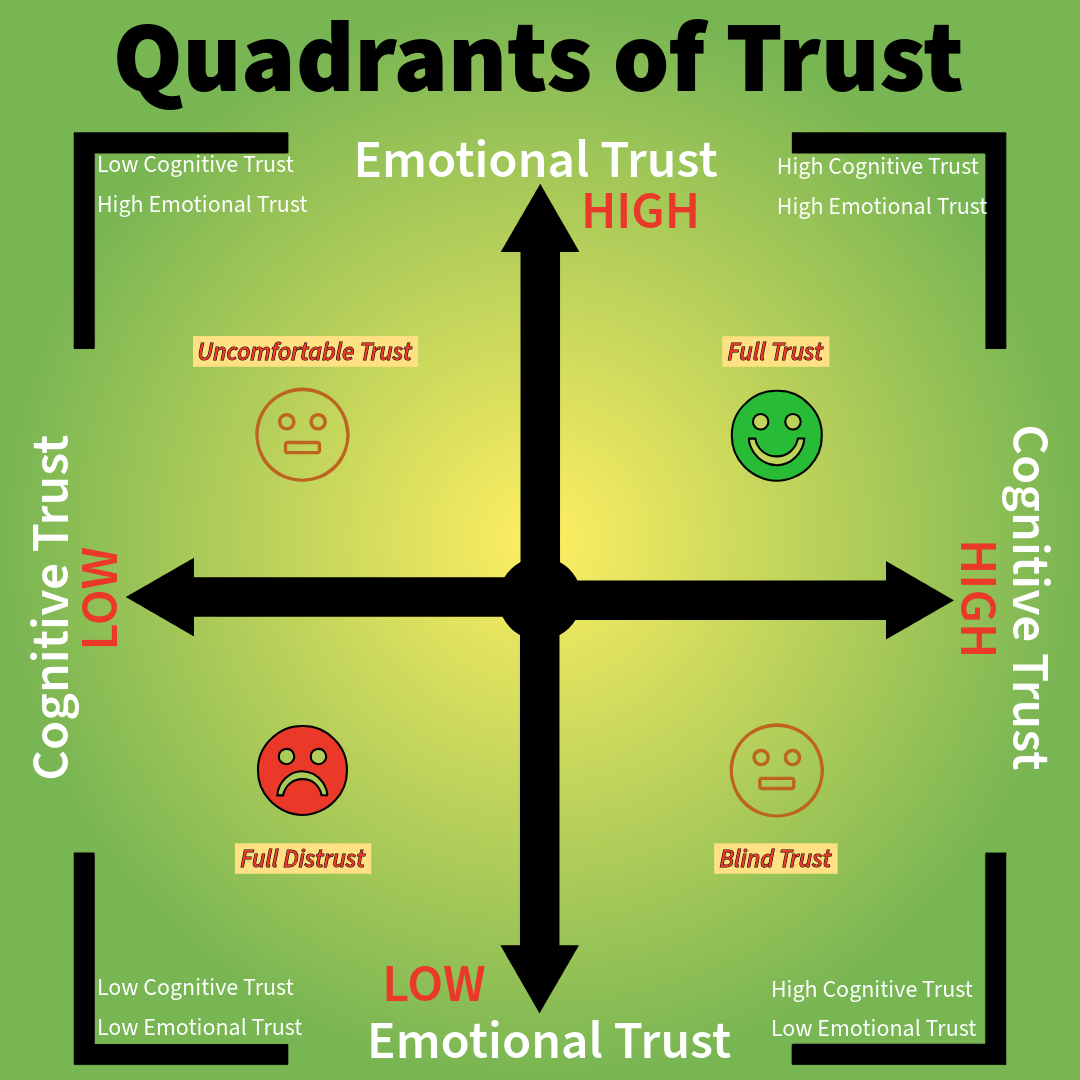
What does the graph show? While figures are not available, the concept is clear that most businesses are struggling to help their users see the value in AI. Look at it like this:
 Full Trust ↑ Cognitive ↑ Emotional |
 Uncomfortable Trust ↑ Cognitive ↓ Emotional |
 Blind Trust ↓ Cognitive ↑ Emotional |
 Full Distrust ↓ Cognitive ↓ Emotional |
|---|---|---|---|
| Around 25% of employees | Around 25% of employees | Around 35% of employees | Around 15% of employees |
| Augementation Trust in the AI's skills and integrity (cognitive) and also feel a strong personal connection/sense of safety with them (emotional). | The Trap Trust in AI's capabilities to do a job well, but no strong personal rapport or connection. | Novelty High emotional bond/feelings for AI or an authority such as management, but no trust in the judgment/skill of AI. | Rejection Distrust on both levels. No trust in the technology's capabilities nor a feeling of any emotional safety or connection. |
| “It is deeply reliable, and it amplifies my unique judgement.” | “It is exceptionally capable, and it is going to replace me.” | “It feels friendly and fun, but I can't bet my deliverables on it.” | “It doesn't work, and it threatens my workflow.” |
Most corporations are stuck in the High Cognitive, Low Emotional quadrant.
Leaders assume that if they procure a more accurate model, write better documentation, or run another training seminar, adoption will naturally tick upward. This is a fundamental misunderstanding of human nature.If an employee believes that mastering a tool will directly lead to their own layoff, their logical, self-preserving action is to ensure that tool fails. They will not feed it high-quality data. They will not integrate it into their daily habits. They will quietly run their manual processes in the background while paying lip service to the “new system”.
The bottle-neck isn’t a lack of technical training; it is a profound deficit of emotional safety.
🛠️ Moving to High-Emotional Trust: A Blueprint for Leaders
If you want to move your organization from the threat quadrant into the high-performance quadrant of true Augmented Intelligence (AuI), you must shift your deployment strategy.
- Shift the Narrative from “Replacement” to “Augmentation”
Stop talking about "headcount reduction" and "FTE savings" in the same breath as your AI roadmap. If your employees hear that AI is a tool to cut costs, they will treat it as a hostile invader. Frame AI as an assistant designed to absorb the repetitive, low-value work so they can focus on high-leverage decision-making. - Establish “Safe to Fail” Sandboxes
In a culture that penalizes errors, employees will never trust a probabilistic tool like AI. Give your team permission to experiment, fail, and document the limitations of AI without risking their performance reviews. Emotional trust grows when employees feel they have control over the tool, rather than the tool having control over them. - Incentivize the “Human-in-the-Loop”
Do not reward those who blindly copy-paste AI outputs. Reward employees who apply critical thinking, edit the AI's work, and act as the essential qualitative gatekeepers. When you celebrate human judgment as the ultimate value-add, you reaffirm the employee's place in the future of the company.
📌 The Bottom Line
Your AI budget is being wasted if your workforce is too terrified to use it effectively.True productivity doesn't come from the raw intelligence of your models; it comes from the frictionless collaboration between those models and your people. Stop asking if your AI is smart enough. Start asking if your culture is safe enough to let it work.
AI Disclaimers
🛑 The Disclaimer Paradox:
How “Cover-Your-Asset” UX is Quietly Killing AI Adoption
Every time a company slaps a boilerplate disclaimer at the bottom of an AI interface warning that the system ‘may display inaccurate information and should be double-checked’, they aren't just protecting themselves from liability—they are quietly euthanizing user trust.
It is the digital equivalent of a commercial airline captain welcoming passengers aboard by advising them to bring their own parachutes because the engines occasionally cut out. In a single sentence, these disclaimers perform a devastating double-strike: they break the user's cognitive trust by admitting the product is unreliable, while completely destroying emotional trust by shifting the entire burden of risk onto the user's shoulders.
Walk into any corporate boardroom, and you will hear executives asking why their highly anticipated AI initiatives are suffering from low adoption and spotty engagement.
The culprit isn’t a lack of training or a poor feature set. Often, it is a single, permanent line of gray text sitting right below the text input box: 
To a legal department, this disclaimer is a masterpiece of risk mitigation. To the end-user, it is a profound psychological red flag. It is the ultimate corporate “bait-and-switch”: selling a revolutionary cognitive leap while simultaneously whispering that you’d be a fool to rely on it.
By analyzing this through the dual lens of cognitive and emotional trust, we can see exactly why these disclaimers are actively sabotaging enterprise AI adoption. See the earlier article about AI Trust Factors to understand more about these two human factors of trust.

Cognitive trust is built on predictability, competence, and reliability. When an employee uses a tool, they expect it to reduce their cognitive load. A disclaimer does the exact opposite! The moment an AI warns a user to “double-check everything,” it transitions from a time-saving assistant to an untrustworthy intern. If a professional has to manually audit every single claim, source, and formula the AI generates, the promised efficiency gains vanish.
When cognitive trust is degraded, the user decides that doing the task manually from the start is faster and safer than auditing a hallucinating machine. When emotional trust is broken, employees protect themselves the only logical way they can: by refusing to use the system for anything that actually matters.
Emotional trust is built on vulnerability, psychological safety, and mutual support. In a healthy workplace, tools are designed to make employees feel confident and capable. The standard AI disclaimer completely destroys this safety net by offloading liability to users to “double-check its responses” which is incredibly cynical. It translates to: “If this AI makes a high-stakes mistake and you don't catch it, it’s your fault, not ours”.
🛠️ The Way Forward: Moving Past Defensive UX
If companies want to realize the true ROI of AI, they must transition from defensive, legal-first design to trust-first design.
- Build Verification Into the Interface Don't tell users to “double-check” in a vague footnote; give them the tools to do it instantly. Build in inline citations, direct links to source documents, and confidence-score indicators. Show the user why they can trust a specific output.
- Segment by Risk Profile Not all tasks require the same level of legal indemnity. A creative brainstorming tool doesn't need the same terrifying disclaimer as an automated financial reporting pipeline. Match the level of warning to the actual risk of the task.
- Share the Risk If leadership wants employees to embrace AI-driven workflows, they must explicitly state that the company stands behind them. Create a culture where catching an AI error is seen as a normal part of the collaborative editing process, rather than a fireable oversight by the human operator.
📌 The Bottom Line
You cannot build a culture of innovation on a foundation of fear.If your user interface starts with a warning label, do not be surprised when your employees treat your expensive new AI platform like a biohazard.
It’s time to stop designing to protect our legal departments, and start designing to empower our people.
Bring the Boy will do everything we can to implement these verification and segmentation regimen into our tools by design. We hope that our customers will in-turn choose to share the risk when their employees use our AuI tools. We might not always get it right at the start, but we will keep trying.